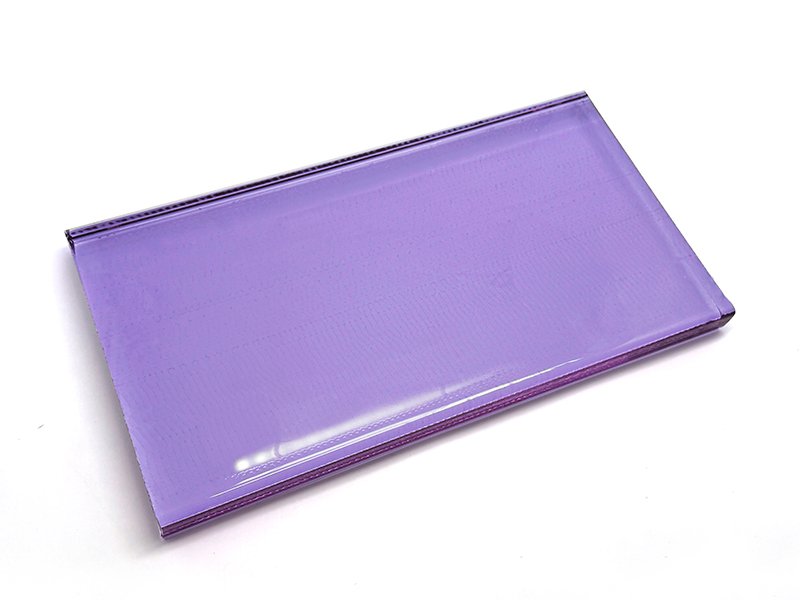
Colored crystal glass and tempered glass are two glass materials with distinct characteristics and application scenarios. Their core differences lie in their processes, properties, appearances, and applicable fields. The following provides a comparative analysis from multiple dimensions:
- Process and structural differences: Color crystal glass is formed by coating a colored ceramic glaze on the surface of glass and sintering it at high temperatures (usually 600-800°C) to permanently bond the glaze layer with the glass substrate. The key to its process lies in the formulation of the glaze and the control of the sintering temperature, ensuring uniform color and strong adhesion. Some high-end color crystal glasses also adopt multi-layer coating technology to achieve gradient or three-dimensional effects.
Tempered glass is produced by strengthening ordinary glass through physical or chemical methods. In physical tempering, the glass is heated to a temperature close to its softening point (around 650-700°C) and then rapidly cooled using high-pressure cold air, resulting in a compressive stress layer on the surface and a tensile stress layer inside. Chemical tempering, on the other hand, enhances surface strength through ion exchange (such as replacing sodium ions with potassium ions). The core process parameters include heating temperature, cooling rate, and ion exchange time.
2. Performance Comparison – Mechanical Strength: Tempered glass exhibits an impact resistance 3-5 times greater than ordinary glass, with a bending strength reaching 120-200MPa. The strength of color crystal glass primarily depends on the substrate (if the substrate is ordinary glass, the strength is similar to the original sheet; if it is tempered glass, the strength is enhanced).
Thermal stability: Tempered glass can withstand temperature changes of 200℃ without cracking. Due to the presence of the glaze layer, the thermal expansion coefficient of crystallized glass may differ from that of the substrate, potentially leading to glaze cracking at high temperatures. Its typical temperature tolerance range is 80-100℃.
Safety: After shattering, tempered glass forms small, obtuse-angled particles (with a single piece area of ≤1cm²), reducing the risk of scratches; the shattering pattern of crystallized glass depends on the substrate. If it is ordinary glass, it will shatter into sharp fragments.
Weather resistance: The glaze layer of colored crystal glass can block ultraviolet rays, making it less prone to fading over long-term use; the surface of tempered glass is prone to adsorbing moisture, which may lead to mold spots in humid environments.
3. Appearance and Functional Differences: Crystal glass, with its decorative aspect as its core advantage, boasts a rich array of colors (enabling monochromatic or gradient effects such as red, yellow, and blue), coupled with a high surface glossiness. It is commonly utilized in home appliance panels (like refrigerator doors), interior partitions, decorative murals, and other settings. Its glaze layer can simulate textures like stone and metal, catering to personalized design needs.
Tempered glass is primarily functional, with high transparency (transmittance ≥84%), and is commonly used in scenarios requiring high strength and safety, such as building curtain walls, balcony railings, and car side windows. Some tempered glass is treated with coatings (such as Low-E coatings) to enhance its thermal insulation performance, but its appearance is mainly transparent or light-colored.